1 – Zappos


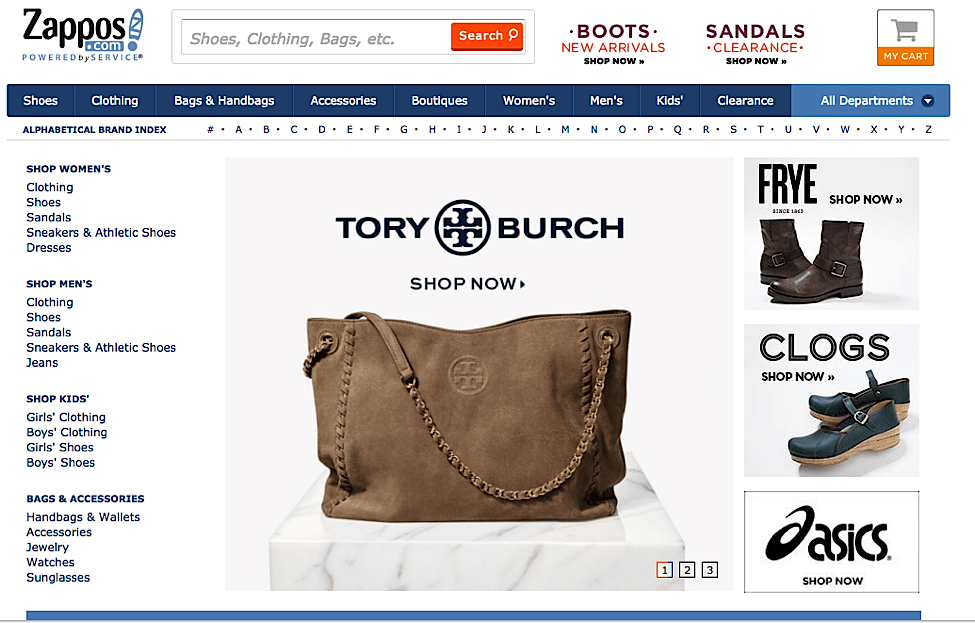
Zappos, a leader in online shoe commerce, sets the gold standard for online customer care. In fact, their CEO wrote the book on it. So it’s no shock that they have a stellar digital strategy.
Not only does Zappos provide a 365-day money back guarantee, but they also have free shipping both ways as well, should consumers decide to return or exchange products purchased on the site.
As a result, Zappos doesn’t have to work hard to market its online presence – its policies are so appealing to consumers that shoppers are eager to sing the company’s praises to one another in a completely organic (and viral) fashion.
Of course, Zappos does still invest heavily in online marketing, and its social media campaigns shouldn’t be missed! Notice how they focus on what the customer wants and needs, not on what they want the customer to want or need. This is a key part to any effective digital strategy. Listen to your audience and plan accordingly.
The Lesson: Content marketing is the way of the future, but it must be managed appropriately to be effective. Online content marketing campaigns should strive to produce measurable results in proportion to the resources committed to them.


2 – American Express (AMEX)
Plenty of companies talk a big game about “the communities” they’re creating online and the inherent value of the “online conversation.” However, very few actually create any community of value.
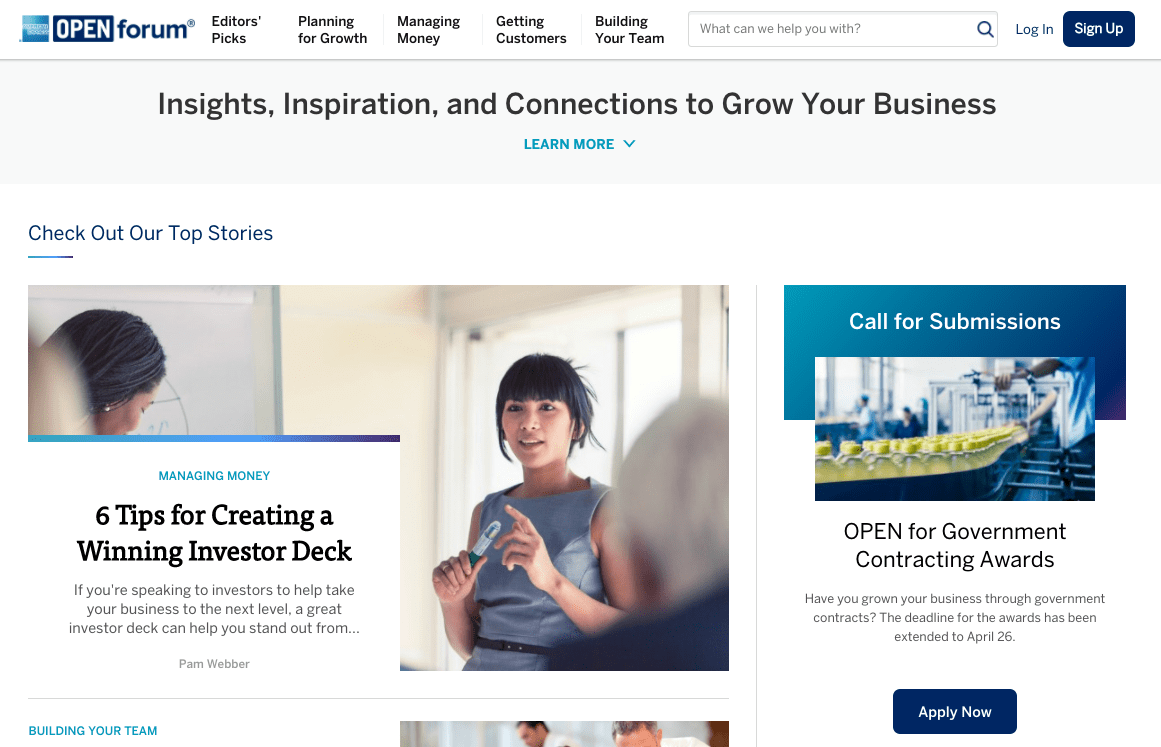
Far from being all talk and no game, American Express puts its money where its mouth is by leveraging the value provided by industry experts on its Open Forum website.
Open Forum is a collaborative website, on which American Express invites guest authors from a variety of sectors to share their business knowledge and wisdom. The result is a content-rich mega-site that’s popular with the search engines – all created without American Express needing to shell out cash to content contributors.
The Lesson: The creator of your content does not need to be you. Find industry leaders that produces great content and ask the to write a couple articles on your blog. It will build their audience and your traffic, as long as the content provides value.
3 – Mint
Entering the crowded personal finance niche (or any popular niche) is a daunting task for any new startup, but the approach that financial tracking tool Mint took proves that it’s possible to stand out in a crowd through well-executed online marketing strategies.
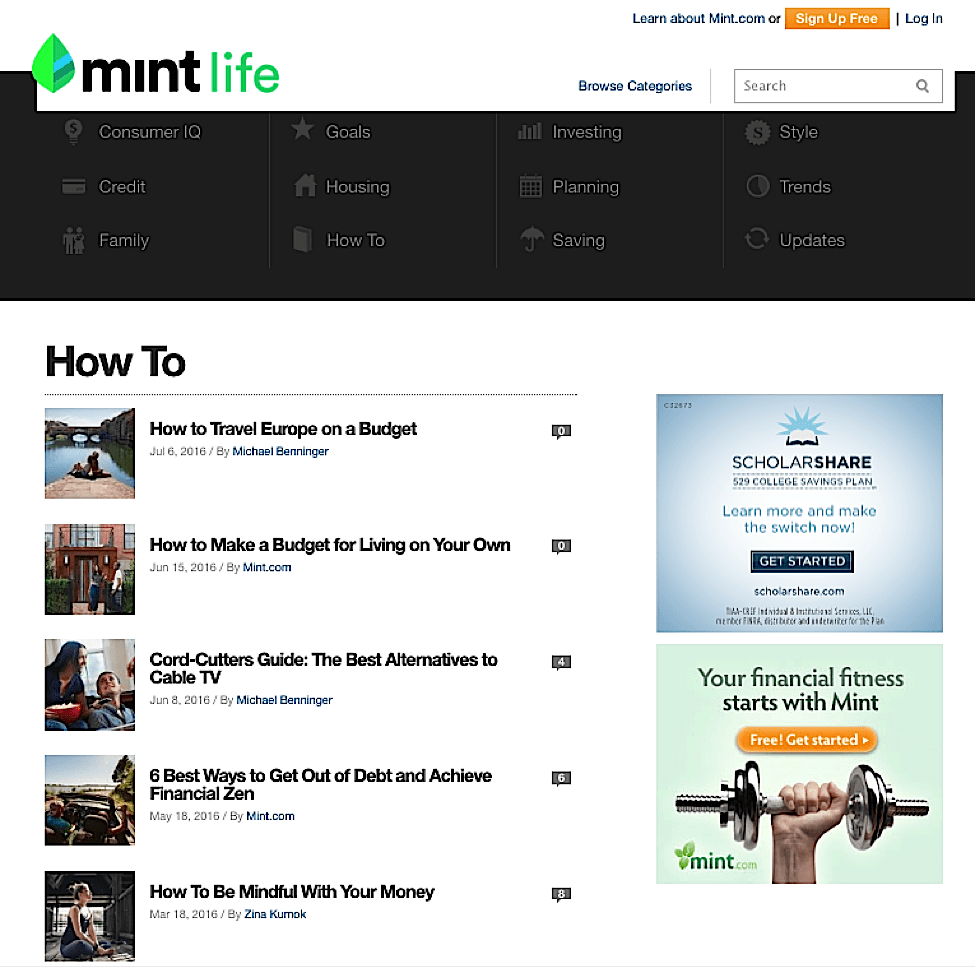
Although the company was a relative unknown amongst its more popular predecessors, Mint committed to a digital strategy publishing hundreds of high-quality content pieces – from informative blog posts to viral attention-grabbing infographics (like A Dude’s Guide to Not Going Broke during Wedding Season) to grow their business.
As a result of Mint’s digital marketing efforts, the tool gained a massive online following before being sold to Intuit for a whopping $170 million.
The Lesson: Investing in content marketing often requires significant amounts of time and money, but committing to content production and high-quality standards can build substantial market attention in a short period of time.
4 – Uber
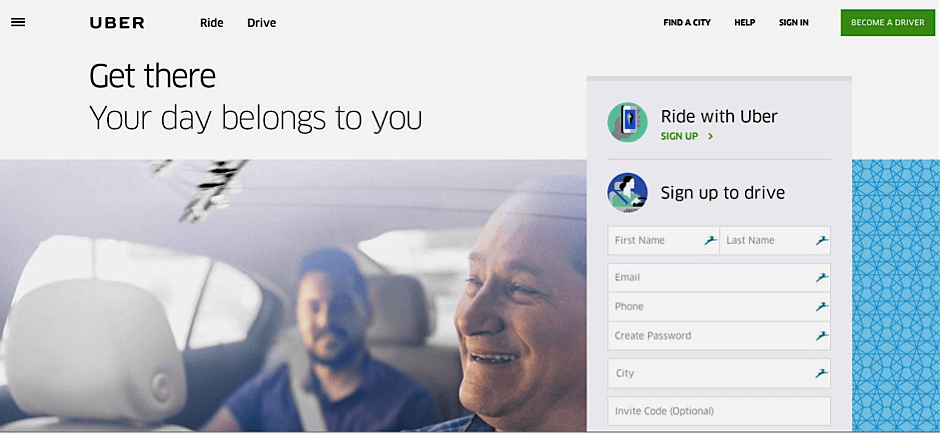
The company started in 2009, but it feels like they’ve always been around. Their service is built upon a luxury that most of us dream of, but few can afford: a private driver. Tap a few buttons on the app and in a matter of minutes, a shiny new car arrives at your exact location to take you anywhere you want to go. The service is so great that the need for expensive marketing is practically non-existent.
Uber grew almost entirely through word-of-mouth marketing, which is a very high converting channel. In fact, according to Nielsen, 84% of customers make purchase decisions based on recommendations from their friends.
They offer incentives for riders to act as advocates for the business by providing referral codes to their friends in exchange for free rides. Between a service that saves people time by making transportation easier and cost-effective and their powerful referral system, Uber spread like wildfire.
The Lesson: Word-of-mouth advertising is worth more than any exposure you could ever buy, and in the digital age, it’s faster and more effective to boot.
5 – The Wirecutter
Affiliate marketing can be a bit sleazy, but it can generate big results when done properly and genuinely. The Wirecutter has set the standard since its launch just five years ago. Labeling itself a simple “list of the best gadgets—like cameras and TVs—for people who don’t want to take a lot of time figuring out what to get,” the site generated $150 million in e-commerce transactions in 2015 and was recently acquired by the New York Times for $30 million.
They write reviews for products they love, embed a link to buy it from someone like Amazon, and take a cut of each sale. Their reviews take anywhere from 20 to 200 hours to complete, involving experts and other interested parties depending on the product.
And it works because they’re real.

The Lesson: Trust more in the power of real people. Modern consumers are wary of ads, banners, and paid search results.
6 – Slack
Slack is a collaboration tool that allows teams to communicate more efficiently and share files, all on one easy platform.
They’ve had a pretty spectacular rise, with 15,000 users at launch in 2014, just north of 171,000 six months later, over 500,000 in less than a year, and currently sitting at roughly 5,000,000 (nearly one and a half million of which are paid accounts).
Their “secret sauce” is delivering a high-quality customer experience. The company responds to 8,000 help desk tickets and up to 10,000 tweets each month. Even their Twitter feed contains a bunch of 140-character #SlackTips.
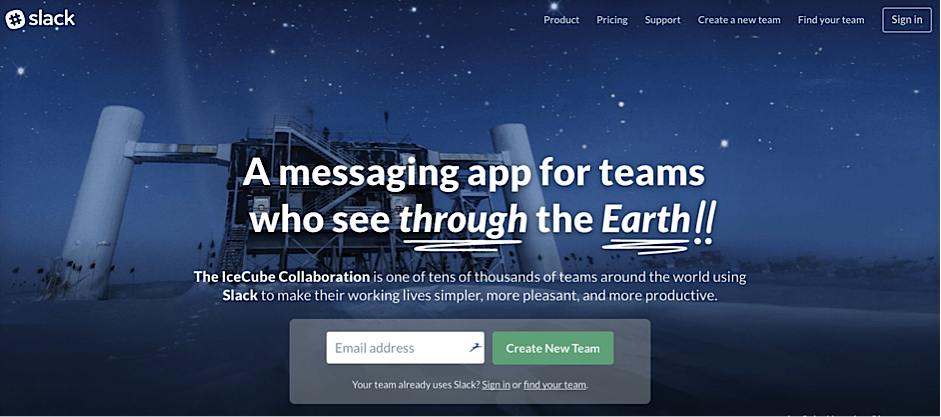
The Lesson: From day one, Slack has been about selling a solution, not a product. They’ve focused on customer experience, believing that one positive experience does more than a big marketing budget could ever hope to accomplish.
7 – JetBlue
One of the biggest mistakes we see companies making when it comes to online marketing strategies is the tendency to post self-promotional materials only. And really, nobody wants to follow a company that can’t stop talking about itself long enough to post something of real value!
JetBlue, the popular discount airline, is one company that gets it. Instead of using Twitter to post fare discounts and special offers, the company uses its handles to provide fast and easy customer service. In fact, the effect is so profound that nearly all the messages in the company’s feed include @ replies, which is highly unusual in the world of social media marketing for businesses.
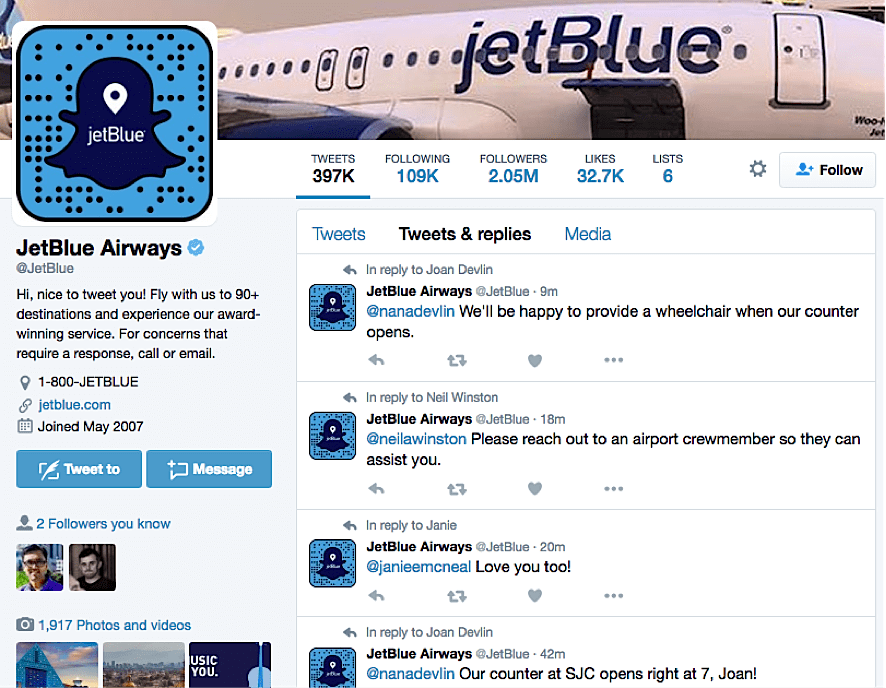
The Lesson: Make it a priority to balance self-promotional materials with information that followers can actually use, and respond to users whenever they interact with your web profiles in order to boost rapport and consumer confidence.
8 – Yelp
It may seem obvious now, but the idea to combine social networking and online reviews was a “Eureka!” moment for its founders in 2004.
It wasn’t that review sites were unheard of at the time, but this company approached it a little differently with the social angle. Today,Yelp has 160 million unique monthly visitors, 2.8 million claimed businesses, and 121 million cumulative reviews.
The social element cashed in on the “people trusting people” component that made The Wirecutter and other similar brands a success years later. Reviewers are real people, with real names and photos, and are encouraged to develop a reputation and a following. Users can even review the reviews of other reviewers!
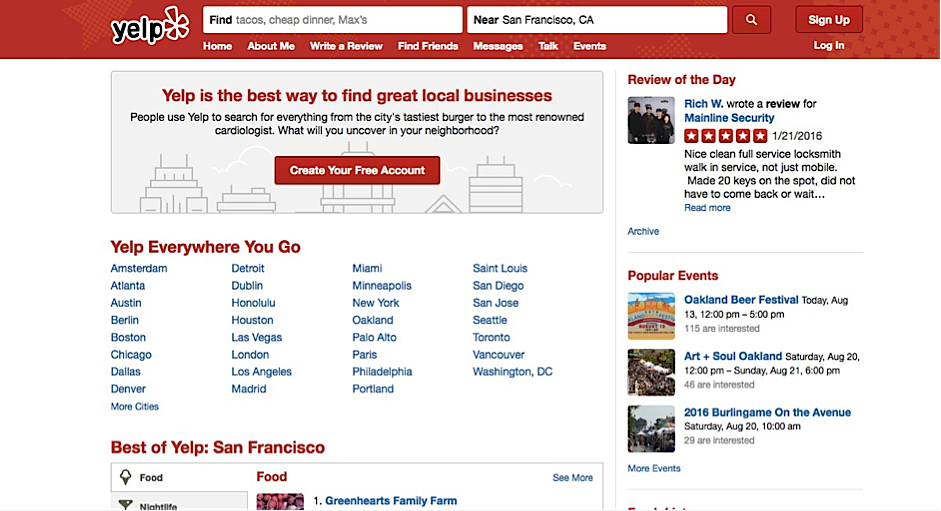
The Lesson: Keep the focus on building a trustworthy brand and a trustworthy community. Yelp wanted to provide the best recommendations for every kind of business.
9 – Mastercard
Mastercard is the king of ‘Priceless’ surprises. The financial services giant has a knack for creating engaging experiences that excite and retain their customers.
As a major sponsor of the MLB, the company wanted to execute their priceless strategy and take advantage of the Chicago Cubs making the World Series for the first time in 71 years. Why? So they could be a part of history if (and when) the Cubs won.
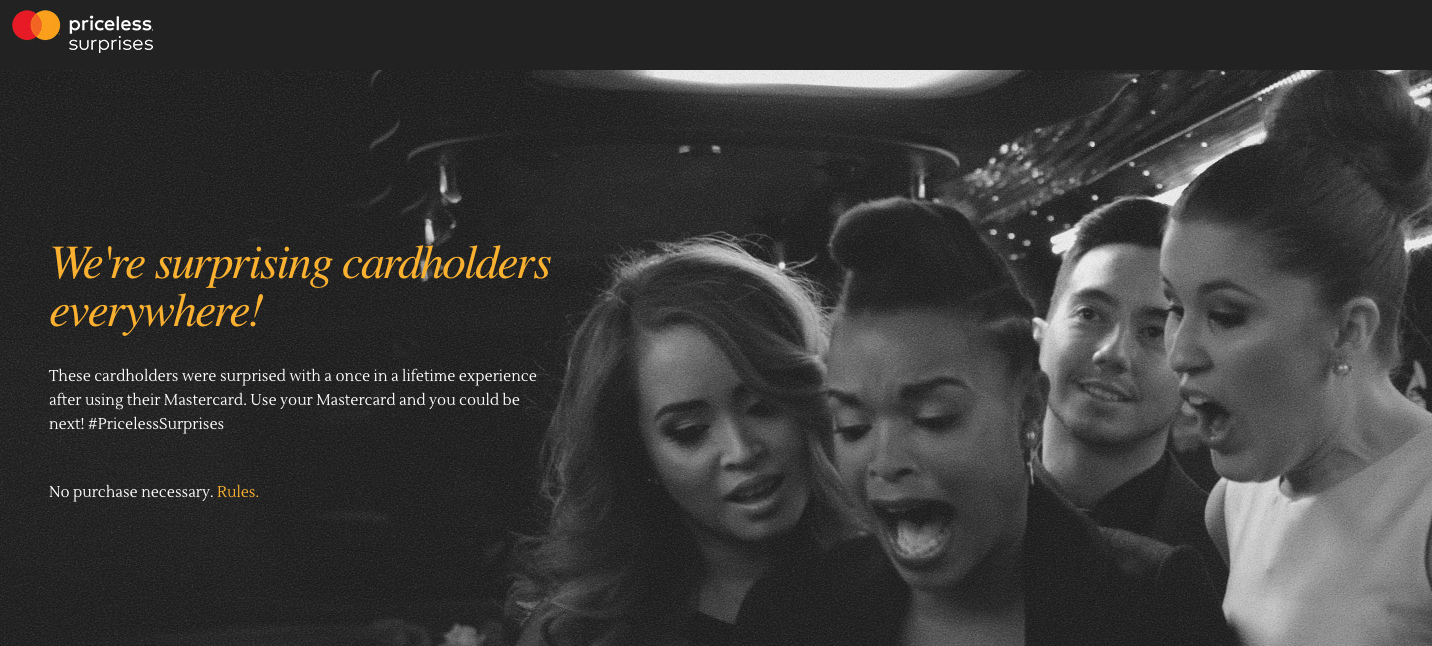
Their main objectives of implementing the campaign were to (1) connect with suffering Cubs fans and (2) insert themselves into the World Series conversation.
Mastercard went out looking for the perfect way to implement their campaign and came across a great piece of content: A player on a rival team had accused Cubs fans of lacking passion for their team. This was a perfect sound bite to build an entire campaign on, so Mastercard ran with it, titling their campaign the ‘Sound of Priceless.’
Then they built a sound meter and placed it around Wrigley Field to measure just how loud the fans were. After measuring the sound, and noticing how loud the fans truly were, they created a piece of video content around the story.
In order to create the ultimate impact, Mastercard released the film online and on social media just as the Cubs won the final game of the World Series. The results were priceless.
The Lesson: When you are trying to create viral digital marketing campaigns, look for content that is already out there and try to create a spin on it that will benefit someone else as well as your brand.
10– Airbnb
Airbnb has changed the way we travel and look for accommodations.
Launched when its founders couldn’t afford their rent, the site now boasts 100 million users, 2.3 million listings, and a total valuation of $31 billion in 2017.
Their marketing strategy is aimed at getting both travelers and hosts for the platform. Its digital marketing relies primarily on user-generated images and videos on Facebook, Instagram, and Twitter (highlighting the cities and properties in its stable), how-to videos and posts geared towards owners, and popular city guides. Their Instagram campaign matches humor with compelling images of different travel locations around the world, making it more than just a service – it’s a travel forum as well.
When it comes to social media superstars, Airbnb shines the brightest. During a 2015 Instagram campaign, the company received 13.3 million interactions and increased followers by 341%.
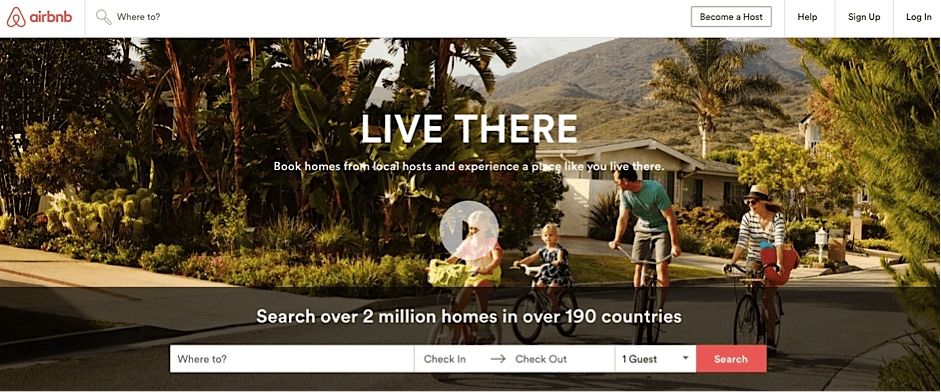
The Lesson: Create demand around your product or service by finding a topic related to your business that’s interesting. For example, Airbnb is ultimately a crowdsourced hotel business, so interesting content for them is related to travel sites around the world.
Comments
Post a Comment